Mikes Insight | 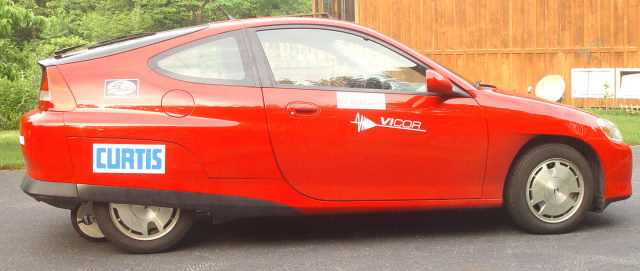 | | | The Batmobile |
In an effort to make it clear that my car has three inter related modifications, not just one, here is the full story about my car:
The MIMA system is one mod,
V-Boost booster battery and controller is the second,
The drop down E-wheel is the third.
I will try to simply explain the complex parts of my cars systems, so many of your questions will be answered.
Hybrid cars have two sources of power to propel the car, a gas engine and electric motor.
How the gas and electric work together is under full automatic computer control on all hybrids today. Toyota's hybrid system called the synergy drive, Honda calls it the IMA.
I refer to the ratio of gas power to electric power that is used to propel the car as the hybrid mix. More electric will yield more MPG. Electric priority means that electric is used for acceleration. Gas for steady state power. Assist is when the electric motor helps push the car, regeneration or regen is when the motor changes to a generator and charges the HV batteries which robs energy and slows the car down like brakes.
MIMA:
MIMA lets the driver be the controller of how much assist and regen there will be, and when it will be applied, thus the M for Manual IMA, or MIMA. It removes control of the IMA from the computer and puts in the drivers hands.
A skilled MIMA driver (yes it involves skill) can boost their MPG by 10-20%, as they learn to be subtle, timely and selective in using assist and will either trickle charge the battery with gentle regen, or dump a lot of charge when decelerating and stopping.The manual control feels great,as you immediately feel that this is how it should have been done to begin with.
The first experience usually brings the MIMA Grin.
V-Boost
MIMA users realize that the MIMA system is limited in the MPG boost it can achieve almost exclusively by how much electric storage the car is carrying.Unlimited battery capacity would allow nearly constant assist, and would bump the MPG to over 100.
Without V-boost, or the soon to be released V-Buck system to increase the effective AH of the pack, we use MIMA carefully to squeeze all the MPG we can out of the system.
Why does this matter?
The stock battery pack holds only a bit more than 4 AH of useable capacity.
Each use of assist drops the charge on the small HV battery.Full assist @ 100A will deplete the 4 AH in only a few minutes.
When you run out of HV,and assist, you will need to put the charge back in. The stock computer will charge at a moderate rate until the charge is replaced. This takes power from either the cars momentum, or from more gas use, as the engine now has the additional load of recharging which will drop your MPG substantially.The stock system will even charge while climbing hills, where anyone would know you want all of your engine power for climbing the hill.
With MIMA, you can control the replenishing charge so that it is only a gentle trickle charge, which will be nearly invisible from a MPG standpoint, in the same category as a light headwind.
The ABC feature of MIMA has a user setable amount of regen whenever the MPG is greater than a user set value, so whenever you are accelerating, the regen stops, and whenever you have a light load on the engine,the small trickle charge accumulates charge in the pack.
Most first time MIMA users want to see how much the electric is contributing to the power mix, so they are not so subtle or discriminating as to using assist, and seem to always find the pack empty or low. The learning curve with MIMA is mainly in learning how to best use the newly gained control of when and how much assist or regen is used.
Here is Randall (Highwater) Burkhalter describing his MIMA driving technique:
Randall's interview
When running with v-Buck on, we make the IMA hybrid system behave like a plugged in rechargeable electric shaver, as long as you don't use the power faster than the charging system can replace it, you can shave forever, or in the case of the car, you can use much more assist, and the pack never needs recharging with the gas engine, so you get super MPG. Once the booster pack is empty, things change, and not only do you go back to having to worry about not running out of HV, but you are now carrying all of the dead weight of the batteries, and they are not helping at all, so the MPG will be worse.
You want to be back home and plugged back into the solar panel before the charge is used up, so you never get into that situation.
E-Wheel
The drop down electrically driven wheel represents the biggest new concept here, and the one that generated the most interest, as it allows the ability to flip a switch, drop an electrically powered E-wheel and drive for 30 or more miles with pure electric drive.An instant EV conversion.
One day of solar charging, and I can go 30 or more miles driving at 30 MPH. This is free, and directly from the sun to the wheels with no carbon production. Infinite MPG,as you are not using gas at all.
The only way to fly.
|
The good
The Insight is a great car, but like all production cars, cost had to be contained, so some comprimises were made.
Lets start with the good stuff.
1. Light weight but strong aluminum and plastic construction.
2. Areodynamic shape
3. Advanced gas engine
4. Simple hybrid drive
5. a suprising amount of room for a 2 seater
6. 60-75 MPG for normal highway speeds |
The bad
The places where they could have done better, but decidied not to, probably because of cost.
1. Incorporating a way to change the ratio of electric to gas.
2. Incorporating more battery capacity so the electric could be used more aggressively.
3. Having a pure electric mode for low speed stop and go or city driving.
4. Having a manual hybrid mode so the driver could use the electric drive to better advantage. |
MIMA the enabler
| 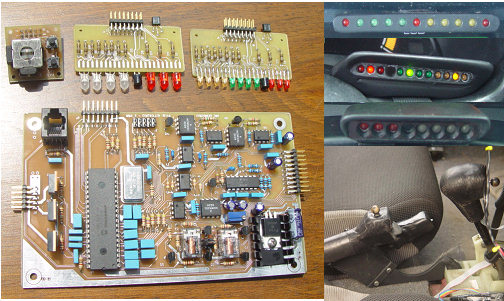 | | | MIMA components |
I had about 79,500 miles on my car when I began modifying it. MIMA or Manual Integrated Motor Assist, was the first modification to the car. MIMA hacked directly into the control system of the car to allow me to use the electric motor as I chose. I used a Microchip PIC processor for the final version,it has analog i/o,plenty of digital I/O and with the flash memory, allows in the field reprogramming.
MIMA allows full assist and regen control of the electric part of the hybrid drive. It consist of a microcontroller based circuit board that ties into the cars harnesses. This new level of control allows the driver to use the assist and regen more effectively than the stock system, mostly due to their ability to see the road ahead, and to anticipate the known terrain of ones daily commute. The system also monitors some of the key signals like battery current in and out of the pack, battery pack temperature, throttle, and MAP signals.
Feedback is via an led display that can be configured for many different mounting positions. The actual control of the system is via a small joystick. Dual controls are possible, so one can mount one control on the shifter, and another where it is convenient during highway cruising. The MAP signal which represents engine vacuum, is tied into the Programmable mode of MIMA called PIMA. This allows operation from the throttle much like the stock system, but with the ability to adjust the MPG that assist and regen activate at, to allow tuning for your typical commute.
The result is between 10-20% MPG improvement |
Need more juice for more MPG
| 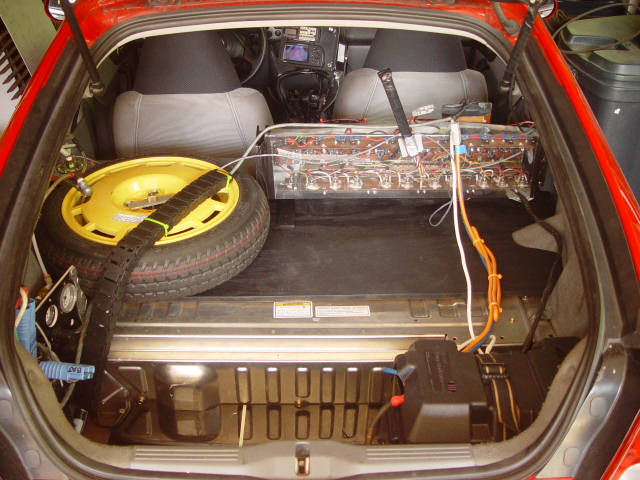 | | | Booster supply and additional Batteries |
It is easily possible to push the MPG to over 100 mpg using MIMA, but you soon find that the higher use of the electric drive leaves the small 144V (4 useable AH) capacity battery always wanting more charge. While replacing the small pack with a larger higher capacity pack would seem the best solution, it is a costly one, as the SOC (State Of Charge) determining system would not be able to properly determine the SOC on the larger pack. The battery management system must also determine if the pack is operating in the safe voltage and temperature range, so any replacement pack would need to duplicate those functions and tie into the cars stock control system. A big reverse engineering task.
I chose a simpler system that retains the stock battery , but applies a boost charge to it through a path that lets all safeties and SOC systems perform normally.
I wanted this boost system to be reasonably priced,(limited budget) so after exploring the NIMH and LION, and LI PO chemistries, and being humbled by their price, I went back to lead acid. It is the lowest cost, but heaviest and lowest capacity solution. 300 Lbs of lead. I installed 4 trojan AGM size 31 batteries in the spare tire well. To get the 48V to the 177V needed to charge the main pack, I built a high power (2900W) dc/dc converter system from off the shelf Vicor DC/DC converters. The boost system is set up as a constant current supply, so that at any voltage of the stock pack, the boost will apply a constant 16.5 A.
While this is only 1/16th the possible max draw of 100A from the stock battery, it is enough so that with conservative use of assist, one can maintain sufficient charge to get over 100 MPG as long as there is charge in the boost battery.
All at normal traffic flow speeds. With the present batteries, I can get about 45 minutes of boost from a full charge.
results:Madison WI 20 miles 121.7 MPG.
Ipswich MA 23 miles 122.6 MPG.
>30-40 mile EV only operation, average speed 27 MPH
MPG infinite. |
Need heavier springs to carry the extra battery weight
| 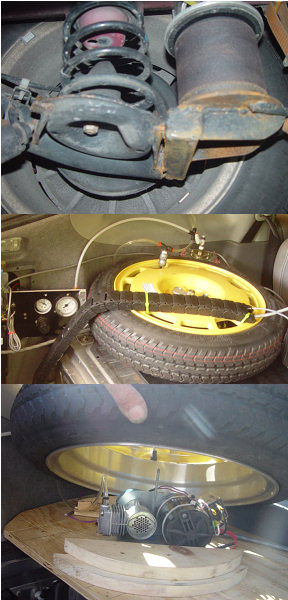 | | | Air system components |
As soon as the 4 batteries were placed in the spare tire box, and the suspension sat right on the overload stops, it was pretty obvious that beefing up the suspension was going to be necessary. After exploring the purchase of heavier springs, I settled on the use of helper air springs.
The advantage of air springs was the ability to adjust the suspension in real time.
If I go to lighter batteries in the future, only a twist of the air regulator will be needed to properly get things back to normal suspension travel.
The air springs require an air supply, so I made one from a 12V compressor, a pressure switch, and used the spare tire as both a cover and an air reservoir.
|
The 5th wheel or Ewheel
| 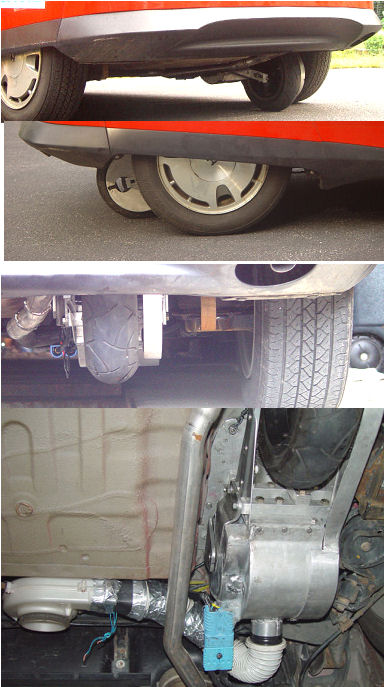 | | | The 5th wheel |
I had the air supply, and the large batteries, why not go all the way and make the Insight have an electric only mode for low speed driving and electric acceleration up to 30 MPH.
I carefully looked at the rear wheels of the Insight, with the idea of driving those wheels with a rear electric motor. The design of the rear suspension and position of the shocks and springs does not lend it self to any type of drive system without nearly a complete rebuilding. I was not confident enough in the concept to risk permanent modifications that may not work as expected. I finally decided to remove the large final muffler in the exhaust system, and use that space for a drop down 5th wheel, powered by the high torque Etek motor, and driven by a scooter wheel. The down force is via a 2.5" bore air cylinder that can produce over 130 lbs of down force. I settled on a 4:1 speed reduction from the motor to the wheel, to get sufficient torque to the ground for blast off, and to allow power for small hill climbing. This 4:1 ratio tops out at 30 MPH with the Etek spinning at 3000 rpm.
At 72V, the Eteck can spin 6K RPM or 55 MPH with this same 4:1 ratio.(room for expansion)
The Curtis company donated one of their 48V 275A PWM motor controllers and control pot assemblies to the project. The Etek can take 300A and up to 72V, but I am running it conservatively at 175A and 48V peak. This gives me about 9-10 HP peak, but the motor can intermittently produce 15 HP. I mounted a temperature probe on the motor so that I could watch the temp while driving. The motor temperature rise was sufficiently fast that I felt the need to air cool the motor. I have just installed the cooling system, and hope to give the 5th wheel an endurance and range test in the near future.
EV first test:
23 miles zero carbon emissions, average speed 27 MPH.
MPG infinate, no gas used, solar recharge for zero carbon production.
Estimate 40-45 mile EV operation |
Does it all work
| 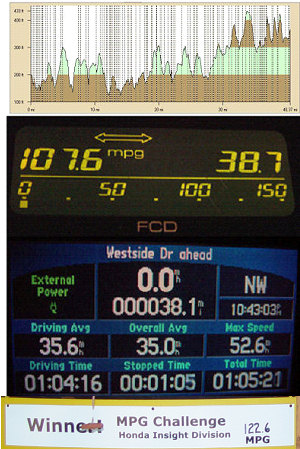 | | | Some MPG test |
The proof is in the results.
It is important to realize that by using what is called Pulse and Glide techniques which involve rather slow speed driving, and a lot of pure engine off coasting that MPG numbers greater than what I am demonstrating can be achieved. It is possible under favorable road conditions to have the motor on to off ratio be as much as 4:1 A great fuel saver when the conditions are right.The down side, the speed is always varying, and it cannot be safely used when in traffic, without effecting the MPG of the other drivers.
I like 55-65 MPH on the highway, and 35-40 on secondary 45 mph speed limit roads.
Any comparison of pure MPG numbers will be quite misleading if the average speed is not considered.
Tour de sol
The course was 200 miles of hilly terrain with a long highway section. My booster batteries and dc/dc converter were functional, but I burned out my charger, so I started the long trek with less than a full charge. The charge was totally depleted in about 30-45 minutes, so the remainder of the race was with no boost but with 300 lbs of batteries. I only got 78.2 MPG on that leg of the race.
I got 92.5 MPG on the drive in 100 mile section (over the Berkshires) with a full charge.
Wayne was the champ, using his P&G techniques to fullest advantage under some nasty conditions.
After the event, I completely rebuilt the 5th wheel which at that time only had a 1/4 HP wheel chair motor, and cleaned up the wiring and other systems. I can now charge the booster batteries from solar or from the power grid.
Midwest Hybrid festival
Drove out to Madison, and thanks to Johnson Controls I was able to borrow 4 Optima yellow top batteries. They were fully charged, and the 5th wheel was fully functional.
The 20 mile course was perfect for pulse and glide, and low speed driving, but I decided to keep to my plan of driving at more or less the normal speed for the roads. At this point in the cars development, I had very limited experience with the system, so I was learning as I drove. I got lost several times, and had to recover, so my times and MPG could have been better. I scored 121.7MPG for the course.
Ipswich Green car festival
The weekend following my return from Madison gave me another opportunity to test my system. The MPG challenge was 23 miles of typical New England roads, including a short section of I-95. Again I got lost, but was able to pull in a 122.6 MPG for the course.
As I gain experience, I expect to be seeing even higher numbers in the near future.
The Ewheel was not used for either of the two races, as the cooling system had not been finished. Can't wait for next years compititions.
|
Filling my electric tank with zero carbon produced electrons
To plug into a coal burning utility grid, sort of reduces the advantages to having a booster battery. I had some solar panels and decided to use them for keeping my batteries charged. I wanted to make simple easy to construct mount for the panels that would be in close proximity to the car in the garage.
I made stainless steel mounting brackets and attached them to each of the 8-50W panels both top and bottom. I screwed the top brackets right into the T-111 siding, and the bottoms to a fir strip 2" X 1.5 ". The angle was set with two wooden standoffs. The DC from the panels is 75V @ ~6A. The solar charge controller is a simple op amp servo circuit set up to turn off the charge when the voltage on the pack gets to a set voltage. The AC charger is a Vicor DC/DC batmod, powered from rectified and filtered AC. A simple flip of a switch switches from one to another.
First EV range test.
23 miles 45% charge remaining, average speed 28 MPH.
It works yea! | 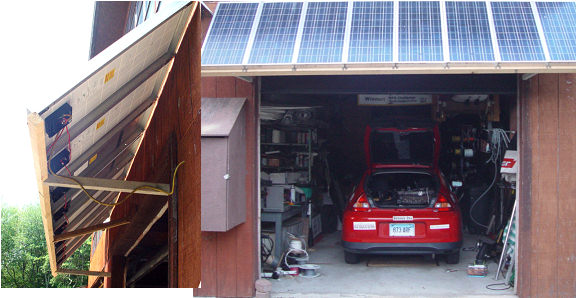 | | | Carbon free charging |
|
Charging while at work
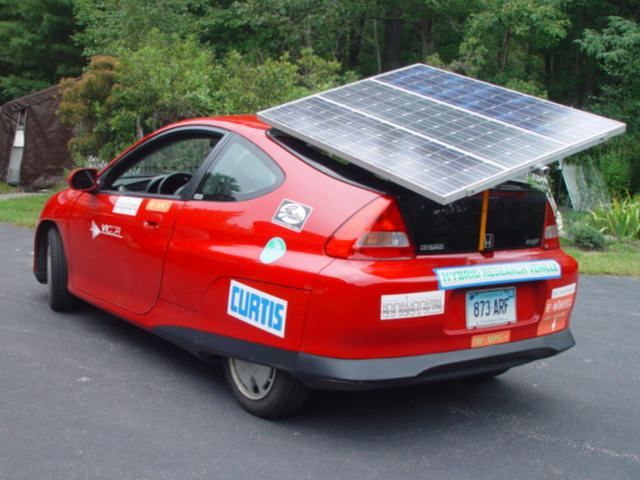
Not being one to sit back and say that's good enough, I again dug into my stuff box and pulled out three 50W solar panels, long and thin, they can fit into my already over crowded vehicle, with out preventing the carring of a passenger.
I welded up a light weight frame that will be tipped with large suction cups for the rear window. The solar panels attach with a single screw with wing nuts so no tools are needed.
|  | | | Chargeing in the driveway |
|
Products and projects: |
